
Why feedback conversations go sideways, even when you think you've been clear.

You've had this conversation already. More than once.
Someone on your team, good at almost everything else, keeps turning in the weekly report late. You've lost count of the Mondays you made staffing calls without it, and you're starting to wonder whether they heard a word you said.
Think back to the first time you brought it up. You started with reassurance.
“You're doing a great job with the team. I really appreciate everything you bring to the table. There's just one area where I'd like to see a little more consistency, and that's getting your reports in on time.”
They nodded. They apologized and promised to do better.
You left feeling good about it. You'd addressed the problem, kept the tone positive, and gotten a commitment to improve.
They left feeling pretty good, too. Their manager thinks they're doing a great job. They just need to get their reports in sooner.
Three months later, the reports are still late. When you finally tell them the missed deadlines are affecting their performance evaluation, they're surprised.
You thought you were communicating a serious concern. They thought they were getting a minor suggestion.
You both remember the conversation. Each of you remembers it meaning something different.
What did you say, and what did they hear?
You spend a lot of time communicating expectations, correcting performance, and helping employees develop. You've probably learned to approach those conversations with some care. You don't want to embarrass people or damage their confidence. You want them to leave knowing you believe they can improve.
The words you choose can carry different meanings depending on which side of the conversation you're sitting on.
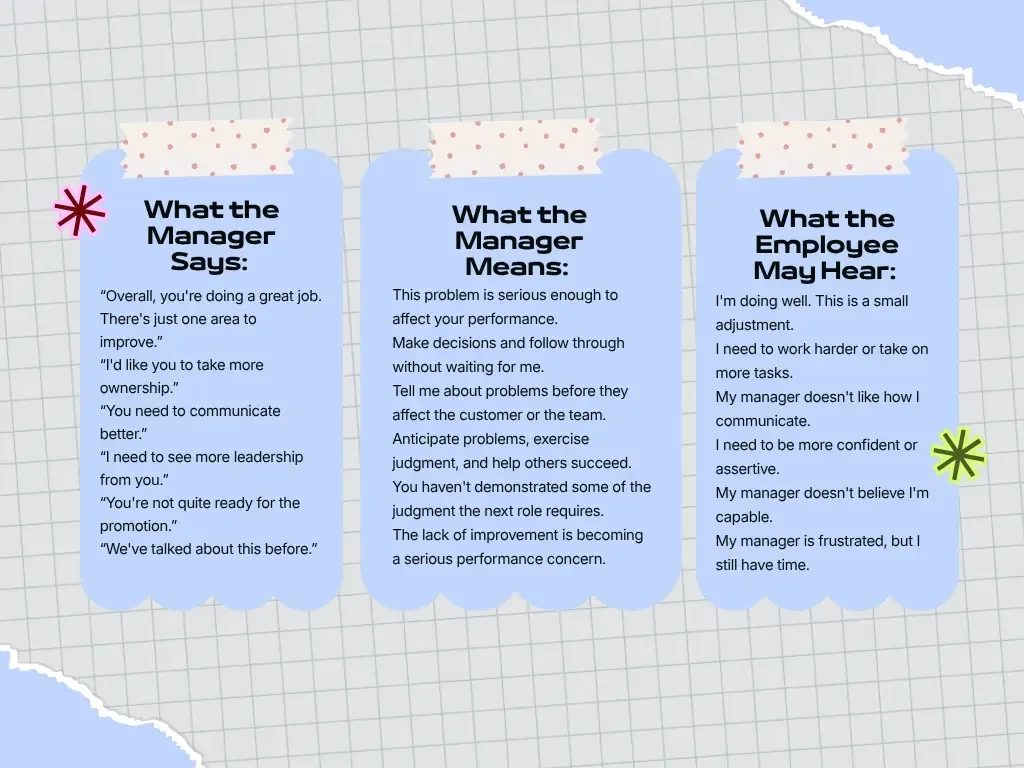
Not every employee would hear these the same way. That's what makes the problem difficult. Two people can hear the same sentence and attach different expectations to it.
And unless one of you asks, neither of you may realize it.
Why does feedback get lost?
Sometimes you soften the message so much that you soften its meaning.
Go back to the opening conversation. You spent far more time praising the employee than explaining the problem. You described repeated missed deadlines as a need for “a little more consistency.”
Nothing in that description tells the employee the issue is serious.
You know that three late reports have delayed staffing decisions and left other people working without information they need. You may have discussed the problem with your own manager or received complaints from another department. You know the consequences are growing.
The employee doesn't necessarily know any of that.
They know their reports have been late, and they know you'd prefer them on time. They don't know how much other people's work depends on those reports.
Without that information, they have no reason to treat the problem as urgent.
Other times, the problem is the language itself.
When you say “take ownership,” you usually have specific behavior in mind. Maybe you want the employee to make routine decisions independently, identify problems earlier, or follow through without reminders.
The words “take ownership” don't tell the employee which of those you mean.
An employee might respond by volunteering for more projects, working longer hours, or sending more frequent updates. They may put considerable effort into improving something you never asked them to improve.
Then comes the next performance review, and you tell them they still aren't showing enough ownership. You both walk away frustrated. The employee believes they've responded to the feedback. You believe they haven't listened. The problem started with an expectation that was never specific enough to act on.
“Does that make sense?”
There's a question you probably ask at the end of a feedback conversation.
“Does that make sense?”
And there's an answer employees often give.
“Yes.”
It's a perfectly ordinary exchange. It also tells you very little about what the employee understood.
They may understand the words you used without understanding the behavior you expect. They may agree that a problem exists and still see it as minor. They may be uncomfortable asking questions, particularly if the conversation involves criticism or their future with the company.
Sometimes they disagree with the feedback and don't feel they can say so.
You hear agreement and consider the conversation complete.
A better way to close is to find out what the employee plans to do with the information.
You might ask, “How are you thinking about approaching this differently next week?”
Or, “What do you see as the biggest obstacle to meeting this expectation?”
Those questions give the employee room to explain their understanding, point out something you've overlooked, or tell you the expectation isn't as straightforward as you think.
You may find out the employee doesn't have access to the information needed to finish the report on time. Maybe another department consistently delivers its numbers late. Maybe the report has become so complicated that finishing it by Friday is no longer realistic.
You might also find out the employee has everything they need and simply hasn't made the deadline a priority.
Those are very different problems. They require different responses.
You can't know which one you're dealing with if the conversation ends at “Does that make sense?”
What does clear feedback sound like?
Go back to the employee with the late reports.
This time, you skip the long reassurance and say:
“I want to talk about your weekly reports. The last three were submitted after the Friday deadline. Those reports are used to make Monday staffing decisions, and when they're late, we have to make those decisions without current information.”
Now the employee knows what happened and why it matters.
You continue.
“I need the completed report by noon every Friday. Before we talk about how to make that happen, I'd like to understand what's been getting in the way.”
That opens the conversation without assuming the cause.
If the employee identifies a genuine obstacle, you have something to address. If the expectation is reasonable and they have the resources to meet it, you can make the required improvement clear.
You can also explain where they stand.
“This has become a recurring performance concern. I want you to succeed here, and I need you to understand that continued missed deadlines will affect your performance evaluation. We'll review the next four reports together and talk about whether anything needs to change in the process.”
You've communicated the behavior, its impact, the expectation, and the seriousness of the concern.
You've also made room to hear information you may not have.
The employee may still miss deadlines. If they do, you both know what was expected and what happens next.
If the issue has reached the point of formal performance action, work through your organization's established process so the employee isn't left guessing about possible consequences.
Employees give feedback, too
There's another side to this.
Your employees give you feedback all the time, although they may not call it that.
An employee says, “I'm overwhelmed.”
You hear a request for help prioritizing.
They may be trying to explain that they're doing work previously assigned to two people, and they don't believe they can keep it up.
An employee says, “I don't think we can meet that deadline.”
You hear resistance or a lack of urgency.
They may know that a supplier is behind schedule, a critical position is vacant, or a process isn't working the way leadership believes it is.
If you assume you understand what the employee means, you may respond to the wrong problem.
Sometimes you're so focused on delivering your message that you miss the information coming back.
That matters because employees often see parts of the work you don't. They know where instructions conflict, where handoffs fail, and which expectations require more time than anyone has allowed.
If you treat every concern as reluctance or every question as resistance, some of that information eventually stops coming.
Your team learns what you're willing to hear.
How do you know the feedback landed?
The next time you have a feedback conversation, pay attention to four things.
What happened? Can you describe the behavior or result without making assumptions about the person's character or motivation?
Why does it matter? Have you explained the effect on customers, coworkers, decisions, or the employee's own performance?
What needs to change? Is the expectation specific enough that the employee knows what to do differently, and have you checked whether they have what they need to do it?
What did the employee understand? Have you given them a chance to explain what they're taking away from the conversation?
None of this requires a script. It requires being willing to find out whether the message you intended to deliver is the one the employee received.
Sometimes that means discovering you weren't nearly as clear as you thought you were.
It's easy to judge a feedback conversation by how it felt. Nobody got upset. The employee seemed receptive. You ended on a positive note.
None of that tells you whether the report will be in by noon on Friday.
A feedback conversation works when the employee understands what you meant, and you understand what they told you in return.
Before you decide your next feedback conversation went well, ask yourself one question: What did this person leave understanding?
Field Notes
Read your own terrain, every Sunday
One leadership signal a week, read through the map, so you know where you're standing and what to do next.
Get the weekly Field NoteOne email a week. Unsubscribe anytime.