
How to Communicate With Senior Leadership as a Manager
The view changes depending on where you sit. Learning to lead means learning what information needs to travel up, down, and across the organization.

When I was a manager, I was sure senior leadership had no idea what it was like to run the operation. Then I became the COO, and I found out the managers had been right about some of it. Leadership couldn't see everything they could see.
The managers couldn't see everything leadership could see, either. As COO I was weighing financial exposure, risk to the company, commitments made in other parts of the business, competing priorities, and consequences that might not reach an operation for months.
Sometimes the decision that best protected the company made a manager's job harder. From the operation, that could look ridiculous. From my desk, it could be the least-bad option on the table.
Both views were right about something, and both were missing something.
Part of becoming a manager is learning to see past your own work
This is one of the harder parts of moving into management, because most people get promoted for being good at the work in front of them. You know the customer, the operation, and what your team can handle. You can see exactly why the new policy won't work the way someone at corporate thinks it will.
That knowledge still matters. As you move up, a second kind starts to matter too:
What is leadership trying to protect?
What's happening somewhere you can't see?
What tradeoff is being made?
What happens if this decision doesn't get made?
What does the person above you need to know that you only know because you're closer to the work?
You can ask all of these and still disagree with the decision. Good senior leaders should be asking the same things about you.
You are often standing between two incomplete views
This gets harder when leadership makes a decision you don't agree with. Your team sees the operational consequences right away, and you probably do too. But now you're their manager, and you have to say something.
The two easy lines are:
"I think this is a great decision."
"I know. I think it's stupid too, but corporate says we have to do it."
The first one asks you to pretend. The second tells your team the people above you don't know what they're doing.
A third line takes more work:
"Here's what I understand about why this decision was made. Here's what it means for us. Here's what we can control. And here's what I'm going to keep communicating upward as we see how it works."
With that line, you're translating between two groups of people who can't fully see each other's terrain.
I didn't know how to do this either
At one point in my career, leadership asked me for a weekly report on my work. I hated it. It felt like micromanagement. I already had plenty to do, and now I was supposed to spend time every week writing down everything I did so someone above me could check on it.
So that's what I gave them: tasks. What I worked on, which meetings I had, which projects were moving. It felt like a complete waste of time, and leadership never read the reports.
I understand now that I didn't know how to tell them what they needed to know. Nobody had taught me. They also didn't know how to develop me.
What senior leaders need from your report
They need to understand what's happening because of the work. Compare these two updates:
Met with Operations and IT about the inventory problem. Continued working on the new process. Training scheduled for next week.
Inventory discrepancies are down since Operations and IT changed the handoff last week. Two failure points remain. We're testing the larger one this week, and I expect to know by Friday whether we can eliminate it without additional labor.
The second one tells me what changed, what still matters, what you're doing about it, and what I should be watching. Someone farther from the work needs exactly that.
Information has to move both ways
As your responsibility grows, part of the job is moving information around the organization.
Look up: what can leadership see that I can't?
Look down: what can my team see that leadership can't?
Look across: who else is affected by what we're doing?
Then translate. Give leadership enough to understand what's happening without making them live inside your task list. Give your team enough context to understand a decision without pretending you know everything that went into it.
When the two views don't match, find out what each side can see before deciding one of them is wrong. Sometimes the thing that looks unreasonable from where you're standing makes more sense once you can see the rest of the map. And sometimes, once leadership can see what you're seeing, the decision needs to change.
One question for your next update
The next time you update your boss, start here: what does my boss understand now because I told them?
That question would have saved me a lot of useless weekly reports.
Need a better way to report up?
The Weekly Status Report is built around four things leadership needs from you: what changed, what matters now, what needs attention, and what's coming next.
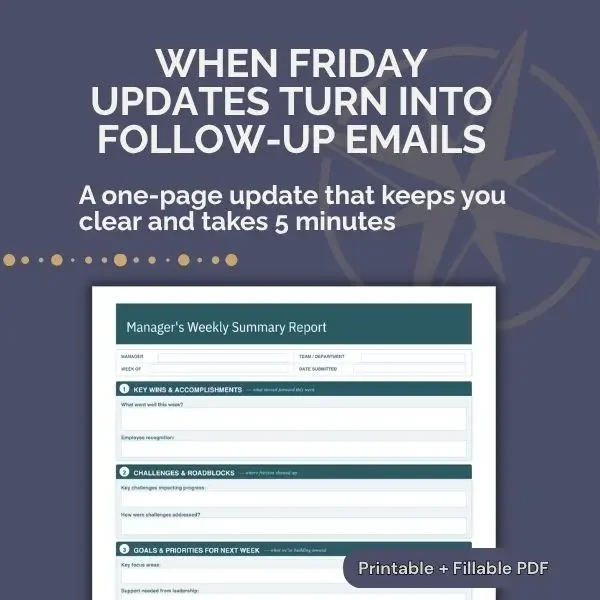
The weekly update eats time you do not have — and still leaves leadership without the full picture
The Manager’s Weekly Summary Report gives managers and team leads a structured one-page format for capturing wins, challenges, priorities, and team updates before the conversation starts. Every section has a purpose. Nothing gets lost because there was no place to put it.
What’s Inside
Key Wins and Accomplishments: space for milestones, completed work, and specific employee recognition — contributions that deserve documentation, not just a mention in passing
Challenges and Roadblocks: what impacted progress, any resource or personnel constraints, and what steps were already taken to address it
Goals and Priorities for Next Week: focus areas, upcoming deliverables, and what support is needed from leadership before the week begins
Employee and Team Updates: staffing changes, training and development gaps, and a morale and engagement check — all in one documented place
Notes and Additional Comments: room for context that does not fit anywhere else but leadership still needs before the conversation
How to Use It
Fill it in at the end of each week — digitally in any PDF reader or printed for desk use. Share it with leadership ahead of your one-on-one or standing weekly meeting so the conversation can go deeper than the recap.
Product Details
Format: Fillable PDF — instant digital download, printable
Pages: 1 — one complete fillable form
Interactive fields: 14 form fields across 5 sections
Brand: The Manager’s Mind Mapping Company / Your Leadership Map™
Field Notes
Read your own terrain, every Sunday
One leadership signal a week, read through the map, so you know where you're standing and what to do next.
Get the weekly Field NoteOne email a week. Unsubscribe anytime.